Beam
24° of nothing else.
The cut-off is where the light stops. Past it, the fitting gives you darkness on purpose.
Tacet 0.7 · Recessed 68 mm
Only what it lands on. So this page has no product photograph at the top — it has a room, and one fixture doing its work in it.
Beam
The cut-off is where the light stops. Past it, the fitting gives you darkness on purpose.
Rise
Dimming follows the eye, not the driver: perceived brightness tracks the square of the setting.
Landing
From 2.8 m, the beam lands as a circle you can measure. Everything here is computed from that geometry.
738 lxø 1.19 m
I — The body
A turned aluminium barrel, a driver that stays out of the ceiling void, and a louvre deep enough that the source never is.
II — The cut-off
The louvre cells are 11 mm deep and 4 mm across. Past 40° from the axis they see metal, not source — so the fitting goes dark before your eye does.
III — Warm dim
Turn it down and the colour falls with it, along the black-body locus, the way a filament does. 2700 K at the top of the throw, 1800 K at the bottom.
One luminaire, one driver setting, three surfaces. What changes is not the light — it is what the room gives back.
A specular floor returns the beam as a second, softer source. The corridor lights itself from below.
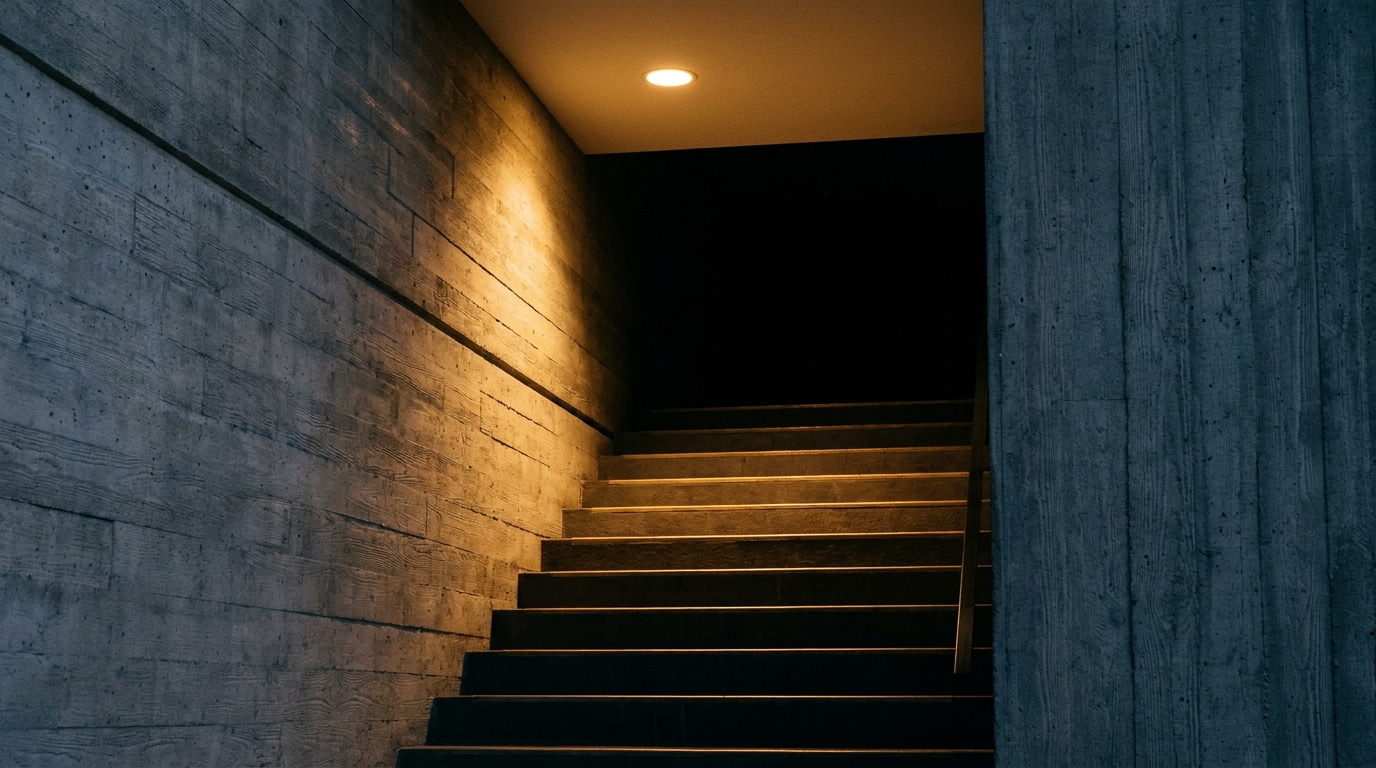
Grazing light is the only way to read a surface. Every tread edge takes a line; the formwork grain comes back.
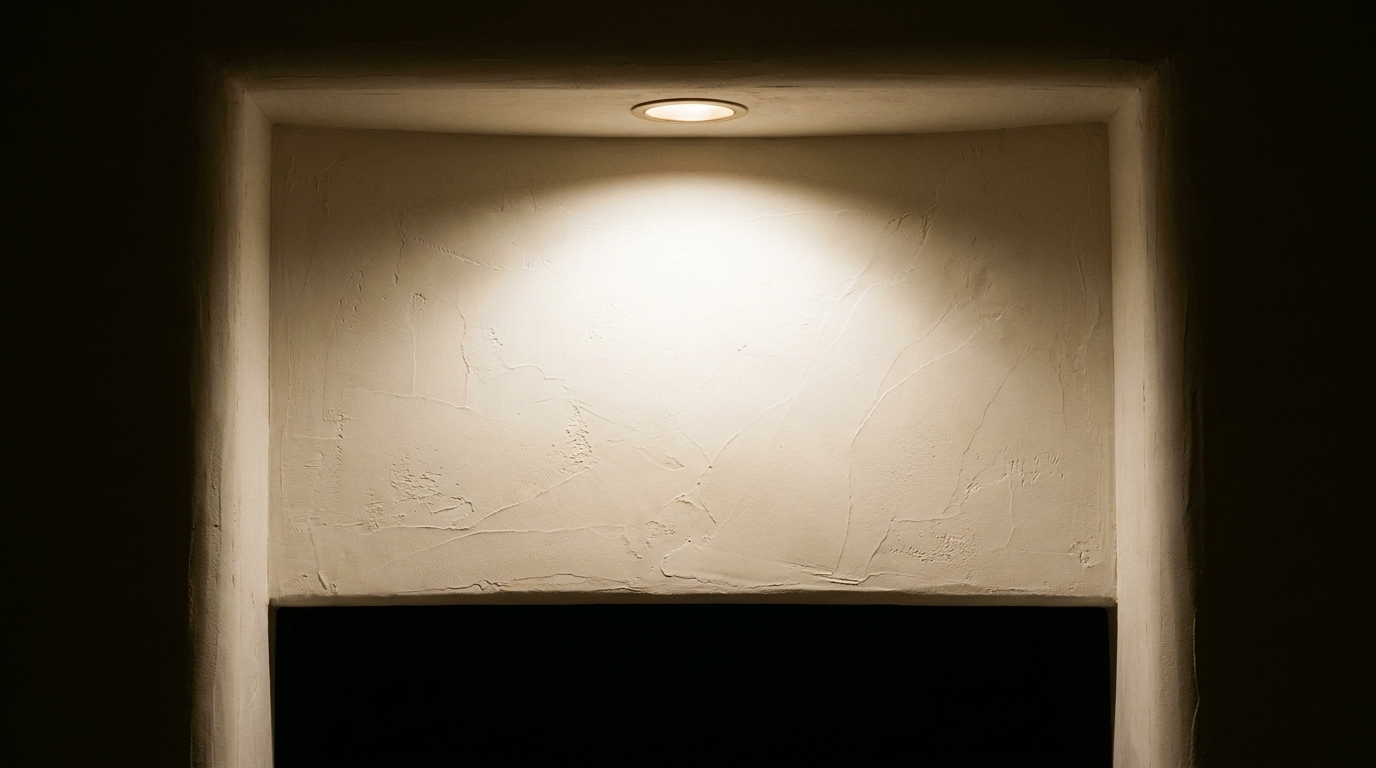
The most forgiving surface in the building, and the one that shows the trowel. A wash, not a spot.
Every figure below is computed in the page from the same model that draws the beam section and the polar plot — flux, solid angle, illuminance, and the locus.